The Great Social Media Reset of 2026
It’s January 2026. You’ve been told for years that “consistency is king,” so you’ve posted every day. You’ve used the hashtags. You’ve followed the marketers who promise “viral hacks.” And yet, when you look at your website traffic or your bottom-line business goals, the needle hasn’t moved.
For many small business owners in the Utah Valley and beyond, social media still feels like a relentless treadmill. You aren’t just tired; you’re frustrated because you see competitors seemingly “winning” the digital game while your social media presence feels stagnant.
The hard truth: Your social media marketing isn’t broken. Your social media strategy is.
According to the 2025 Sprout Social Index, we entered this year with consumers more skeptical of digital marketing than ever before. People no longer want to be “marketed to”; they want to be “connected with.” At Green House Sales and Marketing, a student-led agency powered by the brightest digital natives at Utah Valley University, we’ve analyzed hundreds of social media accounts. We’ve found that the 79% who fail are the ones treating their social media presence like a megaphone. The 21% who succeed are treating it like a growth engine.
This guide is your 2026 blueprint to stopping the random acts of marketing. We are going to dive deep into the A-E-L Framework (Acquisition, Engagement, Loyalty). By the end of this masterclass, you won’t just know what to post, you’ll know why you’re posting it and how to measure social media success in 2026 dollars, not just likes.
Part I: The “Invisible Drain” Why Content Without Strategy Fails
Before we build your new social media marketing strategy, we have to identify why the old one is failing. In marketing, activity does not equal productivity.
1. The 2026 Algorithm & Distrust Trap
Consumers in 2026 are disillusioned with “over-polished” content. If you post low-value, random social media content just to stay consistent, you are actually training the algorithm that your brand is boring. This is the Invisible Drain: every mediocre social media post makes it harder for your high-quality marketing campaign to ever reach the right audience.
2. The Vanity Metric Delusion
In 2026, a “Like” is still not a lead. Followers are not customers. If you have 10,000 followers but 0% conversion, you don’t have a business, you have a hobby. Strategic content marketing focuses on SMART goals: Specific, Measurable, Achievable, Relevant, and Time-bound.
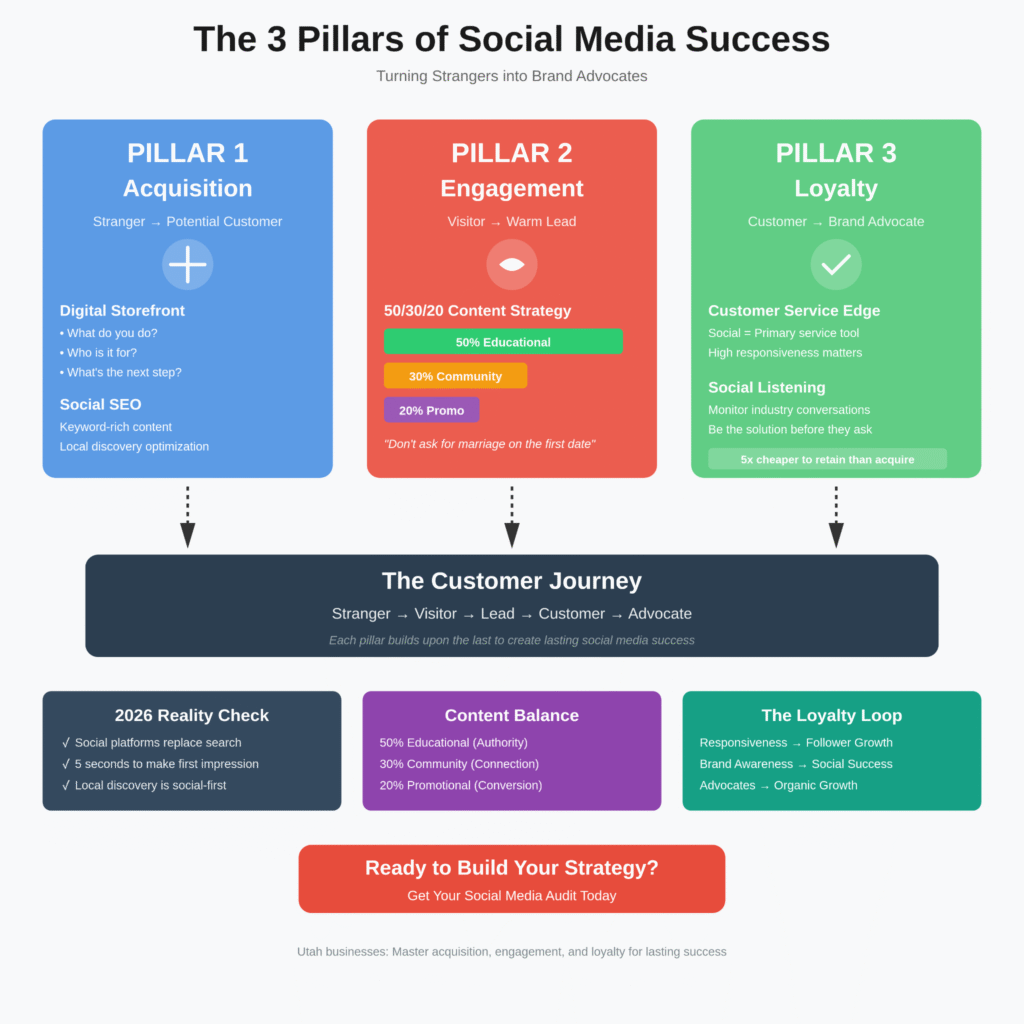
Part II: Pillar 1: Acquisition (The Clarity & Discovery Problem)
Acquisition is the art of turning a total stranger into a potential customer.
In 2026, social media platforms have officially replaced search engines for local discovery. If someone in Provo or Orem searches for a solution on a social platform, is your social media account what they find?
A. The “Digital Storefront” (Profile Optimization)
Your social media channel acts as your first impression. You have exactly five seconds to answer three questions for a visitor:
- What do you do? (Clarity over cleverness).
- Who is your target audience? (Who is it for?).
- What is the next step? (The Call to Action).
B. Social SEO: Beyond the Hashtag
As noted by Sprout Social, platforms now prioritize social listening and keyword-rich captions over simple hashtags.
- Action Step: Instead of a vague brand voice, use your social channel to speak the language of your potential customer. Use keywords your target audience actually types into the search bar (e.g., “Orem Real Estate Expert” or “Affordable Utah Landscaping”).
Part III: Pillar 2: Engagement (The Intention Problem)
Engagement is the process of turning a curious visitor into a warm lead.
Engagement is where customer engagement turns into trust. If you only post social ads, you’re asking for marriage on the first date.
The 50/30/20 Content Strategy Matrix
To keep your social media marketers and audience aligned, follow this balanced “diet” of social media content:
- Educational (50%) – The Authority Builder: Content that provides value and positions your brand as an expert. This is the core of your content strategy.
- Community (30%) – The Human Connection: Related posts that show the people behind the brand. Use your Instagram Story to show “behind-the-scenes” life at your office.
- Promotional (20%) – The Direct Ask: This is where you drive website traffic and sales. Because you’ve provided 80% value, your audience is now willing to hear your pitch.
Turning Attention into Action
Every social media effort must have a social media marketing goal. If you are running a marketing campaign, your social strategy should include a SMART goal for every social media post.
Part IV: Pillar 3: Loyalty (The Connection Problem)
Loyalty is the process of turning a customer into a brand advocate.
In social marketing, it costs 5x more to acquire a new person than to keep loyal customers. Yet, this is often the most neglected part of a social media marketing strategy.
Customer Service as a Competitive Edge
Social media is now the primary customer service tool for local Utah businesses. If a potential customer comments or DMs and you don’t reply, you are effectively ignoring someone standing in your physical store.
- The Loyalty Loop: High responsiveness leads to follower growth, which leads to brand awareness, which finally fuels social media success.
Social Listening: The Pro-Active Strategy
Social listening isn’t just about reading your own notifications. It’s about monitoring the social network for conversations about your industry. By using social listening, you can catch a potential customer’s pain point before your competitor does. This allows your brand to be the solution before the customer even asks.
Learn How Green House Can Help!
Part V: The Green House Edge: Why Digital Natives Win
The people graduating from UVU in 2026 are “Digital Natives.” They don’t have to “learn” a social media platform; they grew up on every social network. When you partner with us, you aren’t just getting “posts” you’re getting a comprehensive social media marketing strategy that includes:
- Audience Research: Knowing exactly where your target audience hangs out in the digital world.
- Content Strategy: Planning recent posts that align with current trends and search intent.
- Goal Alignment: Ensuring every social media effort ties back to your specific business goals.
Part VI: Implementation Your 2026 Social Strategy Audit
To stop the “Invisible Drain” on your marketing budget this year:
- Audit your Social Media Account: Does your brand voice feel consistent across every social channel?
- Check your SMART Goal: Did your recent posts move the needle on brand awareness or website traffic?
- Prioritize Customer Engagement: Spend 15 minutes a day on social listening, respond to your followers, answer questions, and provide customer service.
Conclusion: Stop Shouting, Start Growing
Social media success is the result of a structured system. Acquisition brings them in, Engagement builds trust, and Loyalty keeps them coming back.
Your competitors are likely still on the 2025 treadmill, posting random social media content and hoping for the best. This is your opportunity to leapfrog them.
Ready to turn your social media presence into a lead-generation powerhouse in 2026?
Explore Green House’s custom marketing services today. Let’s build a strategy that actually grows.
FAQ: Frequently Asked Questions
1. Why is a “consistency-only” strategy failing in 2026? Consistency used to be enough to stay visible, but as of 2026, algorithms prioritize relevance and intent over frequency. If you post every day but your content doesn’t spark a specific “SMART goal” action, the platforms will actually reduce your reach. Quality and strategy now outweigh volume.
2. What is the biggest difference between 2025 and 2026 social media? The shift to Social Search. Consumers are no longer just “scrolling”; they are using platforms like TikTok and Instagram as search engines. This makes Social SEO and keyword-rich captions more important than hashtags for acquiring new customers.
3. How do I know which “Pillar” of my strategy is broken? Check your metrics. If you have low views, your Acquisition (Clarity) is the problem. If you have views but no comments or saves, your Engagement (Intention) is weak. If you have customers but no repeat buyers or referrals, your Loyalty (Connection) needs work.
4. Is social media actually a viable customer service channel? Absolutely. In 2026, it will be the preferred channel for many. Recent data shows that 73% of consumers will switch to a competitor if a brand fails to respond to a social media inquiry. Quick, helpful responses are now a core part of brand loyalty.
5. How does a student-led agency like Green House stay competitive? We have a “Digital Native” advantage. Our team at UVU lives in these algorithms every day. By combining our native understanding of new trends with professional oversight and research from tools like the Sprout Social Index, we offer cutting-edge strategy at a price point accessible to small businesses.
Resources & Further Reading
To provide you with the most accurate 2026 insights, we consulted the following industry-leading resources:
- Sprout Social: The 2025 Sprout Social Index™: Social Media Trends & Brand Authenticity. (Read more at sproutsocial.com).
- Adobe Express: 11 Social Media Trends to Watch in 2026. (Guidance on AI-personalization and social search).
- Forbes Advisor: Small Business Social Media Statistics 2025-2026. (Data on consumer purchase behavior).
- Nasdaq / Sprout Research: The Evolution of Social Commerce and Impulse Purchases.
- Utah Valley University (UVU): Professional Sales and Digital Marketing Agency Program Insights. (Explore more at uvu.edu/woodbury).
- Green House Sales and Marketing: The A-E-L Growth Formula and Internal Case Studies (2022-2026).